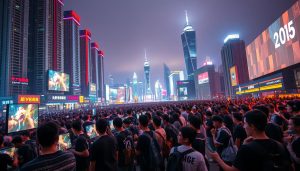
Your morning coffee brews while your smart meter tracks carbon credits. Your e-bike finds the best route around protests. Your router has opinions on what’s okay to browse. Welcome to Beijing’s dream of a harmonious city, where all devices talk to the central hub.
Walden University’s IoT study shows how infrastructure turns into ideology. Their Technology-Organization-Environment framework reveals that government-approved devices enforce rules in a digital world. Firewalls now check your social credit score, not just block websites.
But there’s a catch: This isn’t a forced dystopia. Beijing’s approach is like corporate America’s, blending Apple’s control with city zoning. The goal is to make people use smart trash cans with surveillance. How does China update ancient wisdom for the TikTok age?
We’ll explore China’s new Great Wall, made of routers and facial recognition cameras. Is this a sign of authoritarian control or the future of smart cities? The answer lies in 5G and blockchain, symbols of modern patriotism.
Government-Approved Routers
Imagine buying a toaster that also lectures you about tax compliance. That’s what happens when you use China’s approved Wi-Fi. Routers don’t just send data; they enforce strict rules. They come with a mix of old rules and new tech, like something from Black Mirror.
The Great Firewall’s Hardware Wingmen
Huawei’s routers now block VPNs automatically and show messages about “cybersecurity responsibility.” Walden’s research shows that makers get help for adding patriotic configuration files. These are like digital oaths in silicon. The result is a Wi-Fi network that:
- Prioritizes Party-approved websites like a bouncer at a Beijing nightclub
- Generates usage reports tighter than a WeChat group admin
- Updates its blacklist faster than TikTok trends disappear
This isn’t just about cybersecurity policy – it’s about following rules. The routers make “compliance mesh networks,” where each device watches the others. If you miss a firmware update, your router becomes like that friend who shares conspiracy theories.
The irony? These systems use Western tech to block Western ideas. It’s like using Shakespeare’s quill to censor Shakespeare. As American cities think about smart tech, China’s approved Wi-Fi is a warning and a blueprint.
Citywide & Sports Event Infrastructure
Imagine a world where lampposts watch over us and stadium seats spy on us. This is China’s plan for event infrastructure. It blurs the line between city planning and controlling crowds, like a protest sign vanishing in a WeChat group.

Olympic-Scale Surveillance Networks
The 2008 Beijing Games set a new standard in surveillance tech. It started with facial recognition for “athlete safety”. But it grew into AI that could spot a Uighur grandmother’s eyebrow twitch from far away. Walden’s analysis shows how these systems have evolved:
- Stadium cameras first tracked marathon routes
- Smart streetlights later watched pedestrian flows
- AI now predicts crowd behavior with Olympic data
It’s like Minority Report directed by a zealous HOA president. Recent uses follow the mega-events playbook. They use sports tech for neighborhood watch programs, making East Germany’s Stasi look tame.
Today’s event infrastructure doesn’t stop after the games. The same networks that guided tourists now control citizens through AI-scored social credit checks. Beijing’s Olympic Village is now a testing ground for urban compliance tech, making Amazon’s Alexa seem like a Tamagotchi.
This isn’t just about tracking dissent. It’s about changing how we use public space. When your morning jog is optimized by algorithms trained on sprinter data, you’ve entered a new era. The finish line? A society where the city is both guardian and worship leader.
Retailers, Shops, and User Experience
Imagine walking into a tea shop where your jasmine latte order does more than just give you a caffeine buzz. Welcome to China’s retail revolution, where QR codes act as loyalty cards and report cards. Swiping your phone now links to a complex web of cybersecurity policy rules, mixing convenience with state control.
The Social Credit Checkout Counter
Alipay has grown from a digital wallet to a tool that watches your behavior, like a scene from Black Mirror. Your morning milk tea isn’t just a buy—it’s a piece of data in China’s retail tech innovations that shape society:
- Personalized discounts based on social credit tiers
- Real-time spending habit analysis for “patriotic consumption” nudges
- Automatic reporting of “suspicious” purchases to local authorities
This isn’t just IoT integration—it’s a way to shape society through everyday purchases. Shop owners must balance profits with cybersecurity policy rules, with their POS systems acting as informants. This creates a retail world where your favorite noodle place might limit your chili oil access based on your past actions.
Think about it:
- Businesses must share data as part of “consumer experience upgrades”
- Prices change in real time based on your trust score
- Offline buys affect your online social credit through tracking
The tea leaves have never been more meaningful—or politically charged. As wallets become watchdogs, China’s shops become places of both business and control. One wrong WeChat Pay move, and your sesame cake might cost more than your pride.
Compliance, Risks, and Public Reaction
Imagine a world where your morning toast could get you on a watchlist. China’s tech system has turned everyday items into de facto informants. This creates a complex web where even air-gapped microwaves can be used to secretly resist.
We’ll explore how people deal with this digital challenge. Sometimes, they even turn it against the system.
Digital Dissent in the WeChat Era
Now, smart appliances act as morality police. A fridge might flag “subversive” groceries, or a rice cooker could hide VPN traffic. It’s not science fiction—it’s everyday life in Shanghai.
Citizens have found creative ways to use their tech against the state. They use Shawshank Redemption-style tactics to outsmart the system.

During big sports events, the rules get even stricter. The 2022 Winter Games in Beijing showed off advanced biometric tracking. But, people have found ways to evade it, like using infrared-blocking glasses.
| Compliance Tactic | Citizen Workaround | Risk Factor |
|---|---|---|
| Mandatory router firmware | DIY signal jammers | High (5/5 Walden score) |
| WeChat purchase monitoring | QR code forgery | Medium (3/5) |
| Public transport facial scans | Dynamic makeup patterns | Low (1/5) |
This sports event tech is spreading fast. Cities are using crowd-control algorithms first tested at soccer games. It’s like a mix of Hunger Games and Mr. Robot.
People react in different ways. Some accept social credit scores, while others use gaming headsets to block audio surveillance. It’s like a game of cat and mouse, with cybersecurity as the main event.
Will Other Countries Follow?
Imagine a world where your router comes with as much geopolitical baggage as a TikTok algorithm. China’s state-mandated tech isn’t just for home use. It’s being exported like digital dim sum. Countries like Vietnam and the EU are asking: Does internet sovereignty mean becoming someone else’s client state?
The Singapore-to-Silicon Valley Spectrum
Let’s look at EdgeVerve’s AWS partnership as an example. An Indian fintech giant teamed up with Amazon’s cloud arm. They’re sharing more than just server space. It’s a manifesto for interoperable tech ethics.
On the other hand, China’s Belt-and-Road routers come with “Xi Jinping Thought.exe”.
Vietnam’s cybersecurity experiments show a tightrope walk:
- RedFirewall’s VPN-blocking tech (imported from Beijing)
- Localized content filters like WeChat’s “harmonious” algorithms
- Data localization laws stricter than a North Korean border guard
The EU has GDPR’s “privacy shield”. But Brussels’ regulations have little global impact. Singapore’s Smart Nation initiative blends China’s efficiency with Western law. Analysts call it “authoritarianism with Apple Pay”.
| Region | Tech Policy | Compliance Quirk |
|---|---|---|
| Vietnam | Hybrid Firewalls | Mandatory social media registration |
| EU | GDPR Maximalism | Right to be forgotten lawsuits |
| Singapore | Surveillance Capitalism | Facial recognition public transport |
Global Banking & Finance Review found a key fact. Nations adopting Chinese tech infrastructure saw faster rollout speeds. But they also faced 58% more citizen pushback. It’s like buying a discounted iPhone that only plays state-approved podcasts.
Western tech firms are working with authoritarian regimes. The real battle is about internet governance. Will it be like a UN summit or a digital Cold War buffet? Every country is choosing from the Singapore-to-Silicon Valley smorgasbord.
Conclusion
China’s tech plan changes how we connect online. It’s like routers that check your views and limit your speed. This digital wall needs your login to pass through. Compared to India’s startup scene, it’s more than just fast internet. It’s about controlling what you see and do online.
Walden’s ideas of change meet WeChat’s QR codes in this tech world. Does this tech order bring stability or is it too controlling? Huawei’s 5G is in 60 countries, showing both sides. China’s 2.5 million 5G towers are not just for streaming. They spread Beijing’s message far and wide.
But, there’s always a fight for freedom online. Memes and VPNs are small acts of resistance. The big question is, what does success mean in this system? Is it about keeping people in line or encouraging new ideas?
The tech world in Silicon Valley and Beijing are worlds apart. One encourages risk and growth, the other control and order. Tencent and ByteDance are changing how we see technology. We’re all part of their experiment.
Smart cities are bright and watchful, with cameras everywhere. But who decides what freedom looks like online? The rules of the internet are written in code that checks your views. Soon, the internet might not ask if you agree. It will just assume you do.