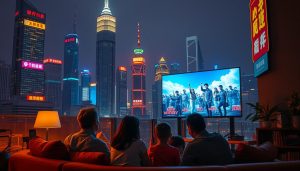
Imagine walking through Beijing’s Tiananmen Square. Every step you take is caught by cameras, like mechanical birds. This isn’t a movie—it’s real life. By 2020, over 626 million cameras watched from street corners, creating a “digital panopticon.”
Then, there’s 5G, the fast new network. It makes life easier, like faster trains and quick food buys with your face. But it also feeds China’s Skynet, a huge surveillance system with 200 million+ cameras. Is this like 1984 but with better internet? Or just a high-tech way to make cities better?
President Xi’s social credit system gives us a hint. Your good behavior, like not being late or jaywalking, can affect your loans. This means being good is like money in the bank. Critics say 5G is about control, not making cities smart. The real question is, “What happens when they never blink?”
The Tech Landscape: 5G Meets Surveillance
Modern cities are turning into digital beings, with invisible connections everywhere. Imagine a city where streetlights collect data and subway turnstiles scan faces. This isn’t just science fiction; it’s what Huawei is creating with 52 global projects.
They’re using a Wal-Mart strategy to offer advanced networks at 60% off. While competitors like Ericsson try to keep up, Huawei is leading the way. But what’s the real cost of having one company control a city’s digital heart?
Take Shenzhen Airport’s face-scanning gates, for example. They’re efficient but also a bit scary. It’s like urban innovation is sneaking up on us, making our lives more convenient but also more controlled. An engineer once said, “We’re not making smart cities. We’re making cities smart enough to track where you sneezed last Tuesday.”
This makes us wonder: Can cities grow without becoming digital prisons? With every camera able to recognize faces, where do we draw the line? The answer could shape our future, making it either like Blade Runner or 1984 – but with better internet.
Sports Events and Mass Gathering Security

Modern stadiums are more than just places for sports. They are living laboratories where your ticket price helps fund new technologies. Remember the “smile surveillance” system in Beijing’s Olympics? It felt like something from a sci-fi movie.
Fast forward to the Hangzhou games last year. Facial scanners there could analyze crowd moods quicker than Taylor Swift changes outfits. The tech has come a long way, from tracking empty seats to spotting “unusual enthusiasm patterns.”
At Qingdao’s beer festival, robot officers were like Wall-E meets Minority Report. They used crowd analytics in real-time, like traffic cops with TikTok smarts. But here’s the twist: the tech used for sports events in Shanghai might soon be used in San Francisco’s subway.
Human Rights Watch has warned about this. They’ve reported on Xinjiang’s QR-coded neighborhoods, showing how “security innovation” can be a double-edged sword.
What if stadium tech is used on a city-wide scale? The difference between keeping fans in check and monitoring political dissenters gets fuzzy. An engineer once joked, “We’re building systems so smart, they’ll detect a pickpocket before he decides to steal.” It’s clever, but who decides what’s suspicious?
Public Attitudes and Privacy Debate
Meet Li Jia, a graphic designer from Shanghai. Her subway trip was flagged as “suspicious activity” because of three stops: pharmacy, bakery, and coffee shop. These stops were seen as “route deviation patterns.” Her reasons? A headache, a croissant craving, and a latte.
College students often say, “I’ve got nothing to hide.” But an activist was arrested for deleted WeChat messages about a banned book club. It’s like your data is both there and not there until needed.
1 million+ people are in “vocational training” camps. This shows oversight goes beyond stolen bikes or traffic. Source 2’s cyber-libertarians wonder: Is this Minority Report-style pre-crime, or a way to control dissent? When your metro card can reveal your secrets, where’s the line between safety and social control?
Young people often ignore privacy concerns. But Li Jia’s coffee break shows city security systems judge life. The question is: Does this belong in a tech showcase or a Black Mirror script?
Implications for Urban Living

My day starts in Shenzhen with a facial scan at Alibaba’s cashless store. I get coffee before I even open my eyes. The traffic lights change for my Uber like magic, and trash bins text City Hall when they’re full. It feels like living in a sci-fi movie.
But what happens when everything is too easy? Deloitte says democracies are falling behind in tech investments by $24 billion. It’s not just about fast internet. It’s about who designs our world.
Our trash cans are old-fashioned, needing us to push a lever. This shows a big gap in urban innovation.
The debate is about convenience versus consent in cities. Smart cities aim for top-notch service, but it can feel controlling. Imagine if your trash habits were judged by the city.
As I navigate through the city, I think about our relationship with technology. Are we building cities that fit us, or are we adjusting to them? The answer could shape our future cities into utopias or strict places.
Future Projections
Imagine Mumbai’s Dharavi slum residents using Huawei-powered networks to scroll TikTok. They’re waiting for their first reliable water pipe. The world is moving towards a digital infrastructure cold war. We’re not just choosing between iOS and Android anymore.
By 2030, we might see neighborhood-level network control. Your internet provider could also track your social score. This is a big change.
China’s tech growth is a warning sign. While Western cities debate facial recognition, Shanghai tests brainwave-monitoring headsets. These devices track what you buy and predict your thoughts.
One report warns of a “digital iron curtain.” This means countries could have their own tech worlds. It’s a scary thought.
Will emerging markets test new tech systems? Think about it: global security investments focus on AI threat detection. This could mean smart city features before basic needs like sewage and electricity.
The big question is: who controls our future tech? Huawei and Ericsson are racing to lead in 6G. Your neighborhood’s network provider could shape your life, from credit scores to voting habits. Choose wisely.
When Smart Cities Outsmart Their Citizens
China’s 5G rollout is more than just building infrastructure. It’s a blueprint for the future. With 350,000 towers built in just five years, Beijing sees connectivity as a competitive sport. Issues.org research shows Huawei’s lower costs in Dutch deals are thanks to government support. This means innovation is funded by the public.
The Digital Silk Road exports more than just fiber optics. It also sends surveillance systems around the world. China Mobile’s 50-city 5G network is a testing ground for social management tools. Silicon Valley’s “disrupt first” approach is mirrored by a system focused on building surveillance systems.
People watch livestreams on subway platforms with facial recognition. Stadiums use AI for security, making Minority Report seem old-fashioned. Privacy debates here seem small compared to Shenzhen’s emotion-detecting camera patents. The future is already here, taking attendance.
KPN learned that cheap tech can have hidden costs. Beijing’s model warns us about the dangers of combining connectivity and control. Your smart city might become the smartest jailer you’ve ever seen.