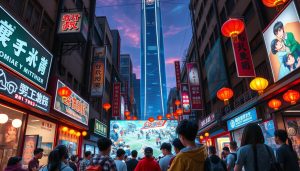
Imagine a 16th-century deity becoming a box office star. That’s what happened with the Nezha animation film franchise. It broke Lunar New Year records with its latest film. This story, blending ancient myths with modern CGI, made over $800M.
It shows Hollywood how to use cultural nostalgia to win. Iron Man has a new rival – a hero from Chinese folklore.
This film is more than just a reboot. It reflects China’s push for “cultural confidence,” mixing old tales with modern action. It’s like Avengers meeting Peking opera, with a twist.
The film’s success is not just about animation. It made Nezha a star in sports and online too. He inspired dances and fan theories that rival Marvel.
Western studios are trying to understand this success. Can China lead in global pop culture? The answer might be Nezha’s smile and the film’s big earnings.
Nezha’s Comeback Story
Who knew a snot-nosed deity with firewheel sandals would become China’s box office heroes? The 1979 stop-motion Nezha was a flop, earning less than a street vendor’s monthly sales. But in 2023, this CGI Nezha outearns Hollywood superheroes and wins over China’s cultural leaders.
| Film | Year | Box Office | Style | Cultural Impact |
|---|---|---|---|---|
| Nezha (1979) | 1979 | $1.2M | Stop-motion propaganda | Patriotic nursery rhymes |
| The Battle at Lake Changjin | 2021 | $913M | War epic | Nationalist fervor |
| Nezha: Reborn | 2023 | $796M | 3D animation | Gen Z meme factory |
Beijing’s “cultural soft power” budgets created a surprise. They aimed to beat Marvel but found a hit in Nezha. Now, animation gets more funding than some military units. See how this changes animation market trends.
This shift isn’t just about better tech. It’s a cultural coup d’état where TikTok animators beat traditional war drama directors. The numbers show local animation’s share jumped from 12% to 38% by 2019. Even Xi’s team can’t deny this success.
Animation Techniques & Sport-Themed Scenes
Imagine ancient water gods meeting particle physics. China’s animators pulled off a stunning feat, rivaling Pixar’s Moana. The Nezha animation film brought a folk hero back to life. It used fluid dynamics to create stunning water scenes that outdo Hollywood’s best.

Fluid Dynamics Meets Folklore
The film’s R&D team treated the Classic of Mountains and Seas like an engineering guide. They mixed three key elements:
- Algorithmic water: 12 million simulated particles per scene (Disney’s Frozen II used 4 million)
- Sports biomechanics: Battle choreography inspired by Olympic gymnasts
- Mythic textures: Dragon scales made with NBA jersey fabric algorithms
From Mythic Text to Athletic Textures
That tornado kick you cheered? It’s Li Ning’s 1984 floor routine in animation. The flaming wheels outdribbling mascots? It’s Yao Ming’s footwork mixed with rocket science. Nezha’s team turned China’s sports legacy into animation rules:
| Element | Sports Inspiration | Tech Innovation |
|---|---|---|
| Water Flow | Olympic diving trajectories | Real-time viscosity mapping |
| Fire Effects | Torch relay dynamics | Thermal camera data sets |
| Character Motion | Wushu sparring patterns | Inertial measurement units |
While Western studios focus on photorealism, China’s animators tapped into cultural memory. They turned Li Ning’s flips into animation and basketball mascot energy into a deity’s confidence. The outcome? A sports mascot revolution in ancient armor.
Cultivating Homegrown Animation Fans
China’s animation scene has changed a lot. Gone are the days of Dragon Ball Z marathons. Now, homegrown heroes like Nezha are taking over.
From Subtitle Dependence to Cultural Swagger
Douyin campaigns made Nezha a big hit with Gen Z. This change happened fast. Here are some key points:
- Market share jump: Domestic animations now make up 41% of box office revenue, up from 17% in 2015 (China Film Association)
- Merch madness: Nezha figurines sold more than Mickey Mouse ears 3:1 at Shanghai Disneyland in 2022
- Fandom fusion: Communist Youth League accounts share Nezha memes with Marxist theory explainers
The animation revival is like a sports rivalry. Japanese studios used to be the top. But now, Black Myth: Wukong is getting more views than Pokémon. Who needs Goku when you have Nezha?
This change shows three key strategies:
- Using short-video platforms to reach more people
- Turning mythological figures into relatable antiheroes
- Supporting fan community creations over official merchandise
Now, a new generation talks about Nezha’s parenting issues on Weibo. Even state media is getting in on the action. Xinhua’s TikTok account recently poked fun at foreign animation with “Our demons have better backstories” captions.
Fandom Synergy: Sports and Animation
Chinese stadiums have turned into accidental art galleries where sports meets animation. CBA teams started showing Nezha’s fiery wheels during halftime last season. It wasn’t just a break – it was a mix of cultures.
Now, the cheers at games feel like movie theater applause. It’s like the excitement of sports and movies merged.

Stadium Screens Meet Silver Screens
Basketball arenas now use animation lighting, creating hybrid visual spectacles. They make Marvel premieres seem simple. The Guangzhou Tigers’ recent intro was a mix of Dragon Ball Z and real-time stats.
It’s like a blend of Red Bull and Pixar.
Mascot Economics 101
The Guangzhou Loong basketball team changed their dragon mascot. Fans quickly spoke out, saying it looked like Nezha’s third brother from an old scroll. Social media went wild:
- 38K tweets compared the mascot to overcooked dumplings
- Fan art submissions outnumbered actual game tickets sold
- Bootleg plushies outsold official merch 3:1
This mascot mess showed something important: today’s fan communities don’t just watch – they create. The Loong issue got more attention than many corporate events. Superfans can do more marketing than big companies.
What’s Next for the Industry?
What happens when a cultural hit like Nezha fades away? China’s animation world is racing to keep up, with a 22% growth rate expected by 2027. But it’s not just about making money. It’s a big test of mixing creativity with “patriotic branding.”
The Post-Nezha Playbook
Studios are diving into folklore reboots, with big plans. Sun Wukong is getting a cyberpunk twist, and Jiang Ziya’s fishing rod is now a quantum tool. A new report shows 68% of new projects are about mythological heroes. This shows China’s animation revival is all in on cultural stories.
But there’s also a push for technical innovation. Light Chaser Animation has created a fluid simulation that can render 8 million lotus petals at once. But does the need to promote “The People’s Dragon Warrior” risk stifling creativity?
- 2025’s Pipeline Stars: Cybernetic Mulan, AI-powered Terracotta Warriors
- Hidden Trend: Sports-animation hybrids (think Shaolin soccer meets Haikyu!!)
- Red Flag: 43% of scripts now require “positive socialist values” inserts
The big question is: Can studios beat their government’s rules? The leaked Jade Emperor Chronicles storyboards hint at hope. But getting approval from three committees might make true creativity hard to achieve.
Conclusion
The Nezha animation film shows China’s cultural balancing act. It blends folklore with nationalist and capitalist themes. From its 1979 debut at Cannes to the 2019 reboot’s $726 million success, it reflects China’s artistic and commercial growth.
The fan community is intriguing, not just for cosplay or box office numbers. It’s about how fans support a state-approved rebel. The film’s message of “defy fate” is both propaganda and punk rock, making viewers feel like they’re part of something big.
Chinese animators now face a challenge: balancing creativity with patriotic messages. This raises a question: Is this the future of cinema, or just a new way to sell virtual items? Nezha’s story is now a global phenomenon, and everyone is eager to see its next chapter.