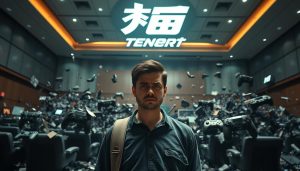
Imagine Icarus, but with a smartphone instead of wax wings. Luo Yonghao, a tech leader, is facing a tough time. His company is dealing with payroll delays and “strategic workforce adjustments”.
Smartisan’s story is like a David vs Goliath tale. It started with viral keynote performances. Remember the 2018 Bird’s Nest event? Luo wowed 37,000 fans, but then faced production delays.
Despite financial losses, fans keep coming back. Luo’s ability to turn mistakes into shows keeps the brand alive. He’s more focused on breaking records than meeting targets.
But investors are losing patience. The question is, will Luo’s story end here, or is it just a pause in China’s tech drama? The outcome is far from certain.
Who is Smartisan?
Smartisan’s start is like a story from P.T. Barnum. It began in 2012 with just 8 million yuan ($1.2M). This was a small amount in Silicon Valley. Yet, it was enough for this Beijing company to become China’s tech sensation.
Luo Yonghao, the founder, was once an English teacher and blogger. He even smashed Siemens refrigerators live on camera to show their flaws.
Luo used his 15 million Weibo followers like a digital circus master. He mixed tech launches with performance art. Here are some key parts of Smartisan’s mix:
- A founder who called Apple “stagnant” while mimicking their product launches
- Keynote speeches that sold out Beijing’s 18,000-seat National Stadium
- Phones named like indie rock albums (Nut Pro, Hammer T2)
But could a company born from viral stunts last in tech? Smartisan’s early days were a mix of real innovation and showmanship. They patented buttonless navigation before Apple’s Dynamic Island. Yet, they also made phones in “Stainless Steel Aluminum Alloy” – a material that doesn’t exist.
Their secret was treating phone launches like Coachella. While Xiaomi focused on specs, Smartisan sold cultural cachet. They even had live-streamed roast sessions targeting competitors. In China’s tech world, they sold more than just phones. They sold a front-row seat to the greatest show on Weibo.
Founder Persona and Marketing Antics
Luo Yonghao didn’t just launch smartphones – he created tech theater. Every product drop was like a mix of Barnum & Bailey and CES. Imagine Steve Jobs smashing iPhones with a sledgehammer to show durability, then charging $150 to watch. That’s the founder drama that made Smartisan China’s most entertaining tech circus.
5,000 fans paid up to $300 for 2018’s “Revolutionary” launch event tickets. That’s $751k, enough to fund a mid-sized startup’s marketing budget. Luo wasn’t selling seats. He was selling FOMO sacrament in a country where China’s EV market strategies show that spectacle sells.
| Luo’s Tactic | Execution | Cultural Resonance |
|---|---|---|
| Paid Launches | $75-$300 tickets for product reveals | Created tech-as-luxury-experience |
| Hammer Origin Story | Literally smashed appliances on stage | Visual metaphor for “destroying mediocrity” |
| Messianic Positioning | “I’m here to save Chinese manufacturing” | Tapped nationalist quality anxieties |
His genius? Turning manufacturing flaws into performance art. When early phones had alignment issues, Luo didn’t apologize. He live-streamed quality control sessions with magnifying glasses and calipers. The message? “Our obsession borders on insanity (and your $800 is well spent).”
But here’s the rub: Can brand hype survive actual product cycles? For all the viral smashing of washing machines (yes, really), Smartisan’s phones kept facing delays. The same theatrics that built anticipation started feeling like distraction choreography. When your launch event costs more than R&D for a new camera module, what exactly are we celebrating?
Luo’s playbook redefined Chinese tech marketing – proving even hardware can be viral content. But as Tesla’s Cybertruck reveals and Apple’s polished keynotes show, there’s a fine line between genius and gimmick. The question isn’t whether founders should entertain, but whether the show ever upstages the substance.
Smartphone Market and Hardware Review
When Smartisan launched the world’s first 1TB smartphone in 2018, many wondered if it was a game-changer or just a show-off. Luo Yonghao, the mind behind this, started by reselling Philips monitors to moms in Shijiazhuang. It was a mix of smart business and early reviews that were a bit confusing.
The 1TB phone raised big questions. Was it a real innovation or just a way to show off? Think about it:
- Average Chinese smartphone storage in 2018: 64GB
- Cost to produce 1TB NAND chips: ≈$200 per device
- Number of users needing 250,000 selfies: Statistically negligible
Luo’s early days of selling monitors taught him a lot. He learned to focus on what people want, not just what’s new. The 1TB phone was more about making a statement than solving a problem.
Now, with phones having 16GB RAM, Smartisan’s move seems smart. But back in 2018, China was different. Most people bought phones for under $300. It was like selling luxury watches at a discount store.
Sports/Health Features: Value or Gimmick?
Smartisan’s step counter got a lot of attention, like a UFC weigh-in. The company introduced sports phone features with a big show. But do these features really help your health, or just make your Instagram look cool?

- “Kung Fu Mode” – Tracks martial arts movements using gyroscopes (because nothing says modern fitness like 15th-century combat techniques)
- Breath Play – Guided meditation with haptic feedback that vibrates like an angry hornet
- Group Challenge – Social fitness leaderboards where overachievers could shame strangers into doing extra burpees
At first, these sports phone features seemed like a mix of Shaolin and Silicon Valley. But, Xiaomi’s health apps did basic step counting better. Apple Watch users quietly reached their Activity rings without all the fuss.
The big question is, did these features work? Some did. But why did a phone company try to be Lifehacker for martial artists? Was it visionary health tech, or just a desperate move?
| Feature | Smartisan | Xiaomi | Apple |
|---|---|---|---|
| Martial Arts Tracking | Yes (Bajiquan-focused) | No | No |
| Social Competition | Public leaderboards | Private groups | Friends only |
| Unique Selling Point | Luo’s personality | Price | Ecosystem |
Users said the punch-tracking was surprisingly good, if you practiced Bajiquan. Others found it as useful as a tofu dumbbell. The bottom line? Smartisan’s sports phone features were unique but not for everyone. In a world where even grandmothers track their tai chi, these features were a bit too specific.
Maybe the real lesson is, in tech, being different only matters if people want what you offer. Unless you’re making a phone for kung fu masters, then ni hao, niche market.
Startup Struggles: Drama and Delays
Smartisan’s journey is like a Silicon Valley drama no one wanted. It had smashed refrigerators, unpaid bills, and executives running away fast. The company’s startup failure was not due to big scandals. Instead, it was from endless delays.
Back then, “perfectionism” meant making products flawless. But for Smartisan, it meant production lines sitting idle while others shipped out.
- 40% workforce reduction in 2018 – like deleting half your contacts before a reunion
- $650,000 owed to Coolpad – smartphone parts held like Final Fantasy loot
- 13-month delays on key models – waiting for Half-Life 3 in tech
Luo Yonghao’s famous fridge-smashing demos became ironic. Suppliers saw Smartisan like that forgetful friend, except the bill was huge. When your CTO cries during board meetings, it’s not about making iPhones. It’s like a corporate soap opera.
The real tragedy? Smartisan wasn’t just any startup. It had 4.7 million loyal users – enough to fill Los Angeles twice. But in tech, keeping up momentum is key. While Xiaomi released Redmi devices fast, Smartisan focused on tiny details.
Here’s the big question: When does being detail-oriented become too much? Their T2 smartphone had a hidden SIM card tray that was hard to open. It was like defusing a bomb. Oppo and Vivo, on the other hand, made devices that just worked.
Smartisan’s story is not just about missed deadlines or bad choices. It shows how startup failure often comes from focusing too much on the wrong things. The market doesn’t care about your vision when there are no products to sell.
Competition and PR Challenges

When your marketing antics attract lawsuits instead of loyalty, you know the brand hype train has derailed. Smartisan’s battle against Huawei and Xiaomi was like a street performer trying to outdo symphony orchestras. It was all flashy gestures, but lacked a sustainable rhythm.
The 2015 Yulong/Coolpad lawsuit was like Smartisan’s Hamlet moment. After claiming “world’s fastest smartphone” titles, Coolpad’s subsidiary sued for false advertising. Suddenly, Luo Yonghao’s viral stunts looked less like genius and more like legal quicksand. Corporate China whispered: “David brought a slingshot to a patent war.”
Analysts pointed out three fatal missteps:
- Prioritizing meme-worthy launches over carrier partnerships
- Mocking competitors’ “boring designs” while lacking mass-market appeal
- Ignoring procurement realities during global chip shortages
While Huawei and Xiaomi played 4D chess:
| Huawei | Xiaomi | Smartisan | |
|---|---|---|---|
| R&D Budget | $22B | $1.5B | $30M |
| Carrier Deals | 86% market | 79% market | 12% market |
| Legal Disputes (2014-2018) | 2 | 3 | 17 |
Smartisan’s brand hype couldn’t make up for selling $500 phones to students. Xiaomi flooded campuses with $150 devices. A Beijing tech blogger said: “They tried to sell skateboards to subway commuters during rush hour.”
The ultimate irony? Those viral keyboard smashes and CEO livestreams made better content than products. In China’s smartphone wars, you either die a meme or live long enough to become the OEM.
Lessons for China Tech Leadership
Li Xiang’s podcast with Luo Yonghao showed more about China’s tech world than any earnings report. Imagine Li Auto’s CEO, who started with smuggled parts, versus Luo, the “Steve Jobs of Chaoyang District”. Their 9-hour talk is a lesson in China’s tech battles.
Three key lessons come from their debate:
- 1. Grey-market grit beats manufactured mystique: Luo used “reality distortion field” speeches, but Li focused on supply chain skills. Li Auto’s EV success comes from this hands-on knowledge.
- 2. Product pivots require surgical precision: Smartisan’s branding was too rigid. Li Auto, on the other hand, smartly moved into electric vehicles, aligning with China’s green goals.
- 3. Leadership theater has an expiration date: Luo’s showmanship faded when faced with real manufacturing challenges. Li’s focus on engineering built investor trust, even through tough times.
The numbers show Li Auto’s success: its market cap is $30B, 15 times Smartisan’s peak. It’s not just about money. It’s about evolving leadership DNA in China’s tech world. Today’s leaders blend charisma with practical skills.
Their podcast showed a key question: Can Chinese tech giants scale what they sell? Li’s success shows the answer is hybrid leadership. Leaders must inspire and manage details well.
China’s tech world is growing up. The lesson is clear: Rhetoric alone won’t build an empire. True success comes from adaptability, supply chain skills, and the courage to pivot when needed.
Conclusion
Luo Yonghao’s 2018 Bird’s Nest event is like ancient hieroglyphics waiting to be understood. Six thousand phones flashing “REINVENT” seemed like a prophecy. It hinted at Smartisan’s journey, a story of innovation and challenges.
Was Luo like Icarus, but with better PR? His Hammer phones faced tough competition from Huawei and Xiaomi. Yet, his fans keep coming back, wondering if his ideas were ahead of their time or just clever tricks.
Now, we wonder what Smartisan’s story really means. Does China’s tech world need more charismatic leaders or less? Can success in supply chains and innovation go hand in hand? The answers could shape the future of tech in China.
Luo’s biggest achievement was making tech drama exciting. But the real challenge is yet to come. Will China’s next tech leader focus on making smartphones or creating spectacles?