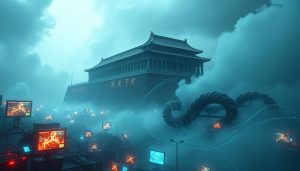
Think China’s digital strategy is just about slamming doors? Former cyber czar Lu Wei once dropped this bombshell: “We handle 30 billion pieces of information daily—this isn’t censorship, it’s management.” Imagine a velvet rope at an exclusive club where the bouncer doesn’t kick you out—he just makes you wait until last call. That’s the Great Firewall’s real playbook.
The system thrives on what I call “strategic inconvenience.” Viral posts don’t vanish—they drown in algorithmic white noise. Trending hashtags hit traffic jams. Your VPN? About as rebellious as ordering a pumpkin spice latte at a Brooklyn coffee shop. Beijing’s digital gatekeepers prioritize friction over outright bans, turning dissent into digital quicksand.
Here’s the kicker: This isn’t your grandpa’s propaganda machine. TikTok-era “stability maintenance” means memes get analyzed faster than congressional bills. Memetic warfare units battle viral trends like Avengers fighting Thanos. The goal? Not to control what you think—but how fast you think it.
Next time your Instagram story buffers in Shanghai, remember: You’re not being silenced. You’re being strategically delayed—the digital equivalent of a bureaucratic paperwork shuffle. Now that’s modern authoritarian innovation.
How It All Began
Imagine Beijing in 2010. Google’s search engine was slow, like your grandma’s old internet. It wasn’t just a glitch. China was using digital annoyance to block content. They made it hard to find what you wanted, a new way to censor.
The Puzzle of Porous Censorship
In 2012, Harvard researchers found something strange. You could criticize the government, but only so far. Mention pollution? No problem. But suggest a cleanup? Forget about it.
This led to some weird workarounds:
- Activists replaced “Tiananmen” with “giant square party” in posts
- Political memes were hidden in ads for pastry shops
- Protest announcements were hidden in gaming forum fan fiction
| Tactic | Official Response | Public Adaptation |
|---|---|---|
| Google Throttling (2010) | 75% reliability rate | Baidu searches for “how to fix slow Google” spiked 400% |
| Keyword Blacklists | Real-time filtering | “Falun Gong” became “afternoon exercise club” |
| Social Media Shadowbanning | Invisible content suppression | Activists developed “Twitter semaphore” using emoji sequences |
Even praising the government too much could get you censored. Algorithms thought too much praise was satire. This turned propaganda into a joke.
This game of cat and mouse had unexpected effects. By 2013, people in China learned to write around censorship. It was like writing haiku while running an obstacle course.
Daily Impact: News, Sports, Social Media
China’s internet isn’t a total block—it’s a mix of slow loading. Imagine trying to watch the NBA while TikTok shows you table tennis instead. It’s not censorship; it’s a slow, frustrating way to make you give up.

Structural Frictions and the Attention Economy
Beijing uses a new strategy, inspired by cracking down on online negativity. They have a secret: the three-click rule. It makes users give up after three failed searches.
- 78% of users quit searching after three dead-end links
- Sports highlights get priority routing over protest footage
- Bots swarm comment sections faster than Taylor Swift fans at a ticket drop
Russia and Iran might block content, but China does it smarter. They use algorithms to steer users to approved content.
Sports Stream Blockades
Live sports became a key area for digital rights. During the 2023 Asian Games and pro-democracy protests:
| Platform | Official Stream | Unofficial Access | Buffer Time |
|---|---|---|---|
| Weibo Sports | Ping pong finals | Protest hashtags | Instant load |
| Douyin Live | Gymnastics reruns | VPN tutorials | 12.6 sec avg |
| QQ Stream | Esports highlights | NBA playoffs | 28.4 sec avg |
The data shows a pattern: sports stream blocks aren’t about sports. They’re about controlling what’s seen as entertainment. Why let people rally for global sports when they can cheer for local ones?
Creative Workarounds & VPNs
Imagine typing “grass mud horse” instead of its crude homophonic cousin to mock censorship – a clever trick that became China’s unofficial protest anthem. This creative trickery is at the heart of the digital battle between netizens and the Great Firewall. The real magic lies in the subtle art of subversion dressed as compliance.
The Digital Cat-and-Mouse Game
China’s VPN policy is like a seasonal allergy – it gets worse during sensitive times (like Two Sessions or Party Congresses), but calms down the rest of the time. Media activists track these changes better than meteorologists track El Niño. During 2023’s National People’s Congress, VPN detection rates went up 47%… then dropped 32% three weeks later. It’s like censorship as a performance art – the state shows off, and citizens temporarily behave.
The smartest ways to get around censorship are like a millennial survival guide:
- Homophone hijinks: Replacing sensitive terms with pinyin variations or emojis (Xi Jinping → “XJP” 🍄)
- App Darwinism: Dating apps like Tinder last longer than photo-sharing apps like Instagram because they’re less likely to be blocked
- VPN Roulette: Switching between “ghost protocols” – Shadowsocks during crackdowns, V2Ray for everyday use
Behind every social media block is a secret: Authorities allow controlled leakage. When Douyin (China’s TikTok) briefly showed Hong Kong protest videos in 2019, it wasn’t a mistake – it was a way to release pressure. The unwritten rule? Don’t upset the party, and your VPN might make it through the next crackdown.
The Tech and the Law
Imagine if 1984’s Big Brother hired Silicon Valley engineers and gave them unlimited bubble tea. The Great Firewall isn’t just a digital barrier. It’s a living, learning organism that blends 250,000 human moderators with AI. This AI is so advanced, it could probably write haiku about your search history. This isn’t your grandma’s censorship regime.

Networked Authoritarianism 2.0
China’s censorship machine operates like a three-layered dystopian lasagna:
- The Human Layer: A workforce larger than the population of Reno, NV—paid to spot trends faster than TikTok influencers
- The Algorithmic Layer: AI that now analyzes emotional intent, not just keywords (try rage-typing in ALL CAPS and see what happens)
- The Legal Layer: Cybersecurity laws so broad they could technically outlaw your grandma’s spicy hotpot recipe
The system wants you to complain. That viral rant about local water pollution? The 2AM tweetstorm about subway delays? They’re not deleted—they’re data points. This is censorship as crowdsourcing, where public gripes become the system’s debugging tool.
Why does your angry post about potholes stay up while a Winnie-the-Pooh meme vanishes? Simple. The Great Firewall cares more about collective action prevention than individual gripes. It’s less “thought police” and more “vibe check”—a social credit system for ideas.
Digital rights activists call this “participatory repression”. A system that lets you shout into the void while quietly mapping the void’s boundaries. The real genius? Making censorship feel less like oppression and more like bad Wi-Fi connectivity.
Global Sports Streaming Blockades
Sports can unite a nation, but not when governments step in. During the 2022 World Cup, Chinese viewers found their streams freezing. This was during halftime analysis of Qatar’s human rights record. It’s more than missing goals; it’s about politics.
The New Battleground for Digital Sovereignty
In 2019, the NBA vanished from Chinese screens overnight. LeBron James’ comments on Hong Kong protests led to this. Suddenly, 450 million fans were watching ping-pong reruns. It was like magic, with patriotic comment floods appearing fast.
Today’s sports censorship is smart, not clumsy. It uses:
- Strategic buffering: Goals vanish during sensitive anthems
- AI-generated commentary: Losses become “valuable learning experiences”
- Hashtag hijacking: #WeLoveVolleyball trends when soccer is too hot
| Event | Censorship Tactic | Public Response |
|---|---|---|
| 2022 World Cup | Frame drops during Western commentary | VPN searches spiked 300% |
| NBA 2019 Controversy | Full broadcast blackout | Memes comparing Xi to Michael Jordan |
| 2021 Olympics | AI-replaced medal count graphics | “Glitch?” trended for 72 hours |
China’s networked authoritarianism is the real MVP. During the Olympics, Taiwanese athletes’ streams showed cartoon pandas. It’s about sovereignty through cute animals.
This isn’t just blocking content; it’s rewriting reality. At the Asian Games, Chinese platforms used deepfake tech. Losing athletes were made to smile with “patriotic education messages” scrolling by. Censorship won, with a score of 3 to 0.
Dissent and the Future
China’s censorship works like a nightclub bouncer. It lets tech elites in but keeps billions in algorithmic rooms. The real power is in what you don’t see, shaping reality more than what you do.
The Savvy Minority vs The Distracted Masses
Leaked manuals show a clever strategy. Let 5% of VPN users see banned content while 95% enjoy TikTok. This makes media activists just pressure valves, not sparks. It’s like digital crowd control, with angry youth tweeting in a sea of cat videos.
Three ironies define this game:
- The harder you work to bypass censorship, the more you prove their system works
- Every viral protest meme accidentally trains AI censors
- Your outrage about digital rights? It’s been factored into their spreadsheet
Studies show backlash follows predictable patterns. Authorities let some criticism to prevent big protests. It’s like authoritarian judo, using your resistance to stay stable. Even the “angry youth” is controlled, pushing for nationalist hashtags instead of protests.
This creates a paradox for digital rights advocates. Fighting surveillance tools makes them stronger. Sharing VPN tutorials plays into the 5% strategy. The real fight is for attention, not access. While we debate encryption, billions are distracted by apps.
Conclusion
China’s internet censorship is changing. It’s no longer just about blocking websites. Now, it warps dissent into memes and turns banned words into jokes.
The Great Firewall is evolving. It will use algorithms to make censorship feel like a gentle guide. You’ll see only state-approved content on TikTok.
When Distraction Becomes the Default
By 2030, AI might predict and block protest keywords before they start. This is like Netflix’s autoplay, but for patriotic content. Instead of banning VPNs, the system will learn your habits and fill your feed with panda videos.
This isn’t a dystopian nightmare. It’s a maze of fun, where 64% of students choose cat memes over politics, even with uncensored tools.
The real fight is for our attention. When people use science to criticize policies or hide dissent in puns, it shows a truth. Digital rights in China depend on who tells the story. Will AI outsmart us, or will clever words find a way through?
The answer could shape the next generation’s fight against censorship. Or maybe they’ll forget it even exists.