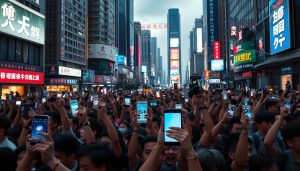
Imagine Orwell’s telescreens being made in Shenzhen, sold with Belt-and-Road financing and facial recognition. This sounds like science fiction but is real when looking at China’s vision-powered empire. I started to understand this after reading the Senate Foreign Relations Committee’s shocking 2020 report. It’s a document that makes 1984 seem like a fun read.
Dahua and Hikvision have more eyes than Netflix. They control 26% of global CCTV systems and use AI to spot “undesirables” quickly. These cameras are far from your grandpa’s security devices. That viral story about systems flagging Uighurs? It’s true, and it’s even more bizarre than fiction.
What worries me? The chance for these cameras to be exported. When Senate investigators called Xinjiang like a Black Mirror episode, they weren’t exaggerating. They were warning about turnkey authoritarianism. These systems watch more than sidewalks; they’re part of social credit schemes, sold with diplomatic loans and labeled “Made in China.”
So, here’s the big question: Can we stop this global rollout before every Main Street turns into Nanjing Road? Let’s look at the plan and why your neighborhood watch might soon carry ideological weight.
Why US/EU Target China for Exports
Imagine a world where your face is like a border checkpoint. Your simple walk to Starbucks is seen as a piece of geopolitical data. This isn’t from a sci-fi show—it’s the global risk that’s making Washington and Brussels act like digital customs officers. The 2019 Commerce Department entity list sanctions were more than just tariffs. They were the start of a battle over what’s normal in the 21st century.

China wants to make cities “smart” with ITU-backed protocols. These protocols include keeping biometric data for 90 days. This isn’t just a problem for GDPR fans. It’s creating a divide where Minority Report meets city planning.
Take Zimbabwe’s CloudWalk, for example. It uses Chinese tech for facial recognition on millions. At the same time, EU lawmakers are trying to update export controls like they’re fixing a bug.
The Techno-Authoritarian Playbook
NIST’s proposed FRVT exclusions show the real goal. It’s not just about blocking gadgets. It’s about stopping a digital governance model that could use social credit scores like SWIFT. When Chinese firms export surveillance tech, they’re sending more than just hardware. They’re sending a global risk framework that makes EU privacy advocates shudder.
Washington’s response is a mix of strategic fear and creative bureaucracy. The real question isn’t “Why now?” It’s “What’s next?” In this digital battle, your face could be the key battleground, whether you like it or not.
Sports Event Security and Tech Showcases
Imagine cheering for your team while literally becoming part of the experiment. Modern sports facilities now double as proving grounds for next-level security systems. Fans rarely get to read the terms of service.
From Belgrade to Doha, the beautiful game’s infrastructure is being rewritten. This is done through camera lenses and facial recognition algorithms.
Huawei’s “Smart Steaua” project in Serbia offers a preview. Their Belgrade stadium upgrades were pitched as fan safety enhancements. They quietly tested crowd-density mapping tools later used in urban monitoring systems.
The real MVP? Qatar’s 2022 World Cup deployed enough AI-powered cameras. They tracked every spilled beer and off-key national anthem rendition across eight stadiums.
Here’s the kicker: UEFA’s strict data privacy rules unintentionally created quality control benchmarks for these systems. When your facial recognition software needs to differentiate between rowdy Liverpool supporters and Norwegian tourists without triggering EU lawsuits, you’ve built a compliance testing playground. Sports venues now provide the perfect cover for refining tools that’ll eventually monitor city squares and subway stations.
As Champions League matches morph into live drills for crowd management tech, one question lingers. When does securing the game start compromising the freedom to enjoy it?
Business, Policy and Market Risks
Imagine buying a toaster that secretly records your breakfast habits and forwards them to Beijing. This is the challenge companies face in today’s data privacy world. From Portland’s ban on facial recognition to IBM’s pause on police tech, ethics and politics are clashing fast.

Microsoft’s change on predictive policing software shows a harsh truth. Even big tech companies find it hard to keep profits and public trust in balance. Remember when Amazon’s Rekognition tool could spot celebrities but not tell peaceful protesters from threats? After public backlash, Jeff Bezos quietly stopped it.
The Encryption Arms Race
Things get really strange here. Huawei’s Senate testimony sounds like a spy story. And Cambodian casinos, once just places for bad decisions, became secret data hubs for foreign players. It makes you ask: When did blackjack tables become the new digital espionage battleground?
Backdoor Economics 101
Axis Communications’ switch to new components shows the game companies play. One day, your security camera is Swedish-made, the next, it’s got CCP-approved software. This isn’t just a story of corporate secrets. It’s a lesson in how data privacy changes whole industries. A lobbyist in Portland said, “We’re not just selling cameras. We’re selling ethical problems with free shipping.”
The Global Game Plan
Remember when wars were fought with tanks and treaties? Now, in 2024, it’s a game of strategy with algorithmic impact assessments. The West is using data sovereignty pacts instead of military bases. Brussels’ conference rooms are now the battlegrounds of the digital age.
The EU’s AI Act is like GDPR’s feisty cousin. It doesn’t just regulate algorithms; it checks every line of code that crosses its borders. Washington’s Clean Network initiative acts as a tech gatekeeper, deciding which foreign cloud providers are allowed in. Together, they’re creating a digital velvet rope around democratic nations.
In Kenya, there’s a choice between Huawei’s affordable 5G and Nokia’s ethical networks. Estonia has “digital embassies” – server farms that act as sovereign territory. These are not just choices; they’re strategic moves in a global game.
The ultimate goal is a world where your phone’s OS shows your political stance. The rules are being made as we speak. They’re hidden in export controls and cloud agreements, all under the guise of ethics and cooperation.
The Thermal Camera Crossroads
Our pandemic hand-sanitizer stations now host thermal scanners tracking more than just fevers. These chips power China’s semiconductor ambitions and its surveillance. Freedom House’s 2023 report shows the internet freedom decline for the 13th year. AI policing tools spread faster than vaccine misinformation.
Huawei’s HiSilicon designs and SMIC’s manufacturing breakthroughs show a truth. Export controls slow the flow but can’t stop determined innovators. China’s 5% global memory chip market share could grow to 10% by 2025.
We’re at a crossroads with two global risk scenarios. One path sees democratic alliances using chip restrictions for digital rights agreements. The other is a splinternet with RISC-V processors and Nvidia GPUs enabling censorship and oppression.
The Snowden-Zoom generation faces its Oppenheimer moment. Can we create surveillance tools that self-destruct after pandemics? Design facial recognition that forgets protestors’ faces? China’s C930 CPU shows open-source architectures could disrupt centralized control if democracies invest early.
Thermal cameras outlasted the pandemic. Will our digital accountability measures survive the next crisis?