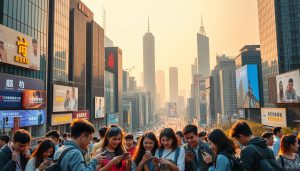
Imagine Mark Zuckerberg facing Congress over 87 million stolen Facebook profiles. But Tencent’s WeChat was quietly mastering the art of disappearing. 2018 was a year of tech surprises – the internet freedom fell for the eighth year in a row. Yet, China’s digital economy grew faster than a viral TikTok dance.
What do the numbers really tell us? On one side, Xi Jinping’s new cybersecurity laws were rolling out fast. On the other, 802 million people were shopping and paying on Alibaba’s Singles’ Day. This wasn’t just growth – it was a controlled demolition of digital boundaries, as shown in the latest China internet report.
The irony? While Western democracies faced data scandals, Beijing built “the Great Firewall 2.0”. It’s both a censorship tool and an economic engine. Social credit systems watched citizens, and facial recognition startups became unicorns. VPN crackdowns got tougher just as Chinese apps went worldwide.
So, can a nation lead in digital innovation and digital authoritarianism at the same time? The 2018 data says yes – they’re two sides of the same WeChat QR code.
Introducing the 2018 Data
2018 was a year of digital privacy’s double face. One side was all about GDPR compliance, while the other was about biometric scans at checkpoints. Europe made big strides in tech policy with new data laws. But, another country quietly sold facial recognition tech to 37 governments.
It was like something out of Black Mirror. In 2018, 26 countries got stricter with digital rules, while 19 relaxed them. Egypt jailed bloggers for “fake news,” and Sri Lanka blocked social media during protests. But, in Kenya, activists used secret chats to outsmart censors.
Venezuela introduced the “Fatherland Card,” tracking everything from votes to shopping. It’s like your shopping habits decide your rights. It’s both chilling and a sign of power control.
This year, the battle between digital freedom and state control was intense. It felt like we had a cybersecurity revolution and an authoritarian tech show at the same time. The biggest shock? Over 3 billion people lived in countries where online freedom got worse. That’s half the world’s population needing a VPN just to read this.
Internet Penetration and User Profiles
We swipe phones for mobile payments without thinking – but what if that latte transaction secretly rated your citizenship? Welcome to digital profiling perfected. While headlines touted “802 million users online,” the real story unfolded in loyalty programs turned social engineering tools.
Alibaba’s Sesame Credit didn’t just track diaper purchases. It weaponized consumer behavior into a dystopian rating system. Imagine your Uber rating determining loan approvals – then add facial recognition vans outside mosques. Suddenly, Black Mirror’s “Nosedive” episode feels like light comedy.
Leaked documents reveal the brutal math: buy halal food online = minus 2 points, stream government content = plus 5. In Xinjiang, these scores became detention warrants for over a million people. Your phone isn’t just a wallet anymore – it’s the ultimate snitch.
Yet here’s the twist: this system needs mobile payments to thrive. Every WeChat transaction feeds the algorithm. Cash leaves no data trail. So next time you tap-to-pay, ask yourself – what’s the real price of convenience?
The E-commerce Surge
While American retailers debated tax incentives for warehouse locations, something far more interesting was happening halfway across the globe. Imagine farmers live-streaming persimmon harvests to millions while luxury resale markets hum through chat apps – this isn’t speculative fiction. It’s today’s $42 billion e-commerce reality where digital marketplaces evolved into symbiotic organisms.
Single’s Day sales now make Black Friday look like a bake sale – $30.8 billion in 24 hours, enough to fund a small nation’s surveillance R&D budget. But the real magic happens in cross-border platforms where Australian vitamins get “rebranded” as premium wellness products through algorithmic alchemy. Western platforms, on the other hand, are stuck on whether two-day shipping is worth a gold star.
What’s the secret sauce? A digital ecosystem where grandma’s homemade chili oil sells alongside limited-edition sneakers, all fueled by social commerce that makes Instagram shopping look like a dial-up experience. The kicker? Every scroll, click, and purchase feeds machine learning models sharper than a Michelin-starred chef’s knife.
As traditional retail stumbles, these hybrid marketplaces prove e-commerce isn’t just about moving products – it’s about creating self-sustaining economies where even surveillance tech pays for itself through checkout carts. Now that’s what I call a loyalty program.
Social Networks and Messaging

A tourist took a selfie in Cairo and posted it on Facebook. They joked about ancient pharaohs, and got an eight-year sentence. A luxury car brand also faced backlash for a Dalai Lama quote on Instagram. This shows how digital diplomacy works today, where tech and politics mix.
Today, companies are playing a game of content limbo. They try to avoid trouble by bending rules. TikTok, for example, has engineers in Palo Alto and censors in Beijing. It’s not just about fun videos; it’s about who gets to tell the story.
Marriott made a mistake by listing Taiwan as a country. They faced a lot of anger online. This shows the power of algorithmic appeasement.
WeChat shows how digital rules can work without physical walls. It’s like McDonald’s removing fries to please potato farmers. But with higher stakes and cool emojis.
Why should Silicon Valley care about a Lebanese tourist’s post? Every deleted post shows new rules. The question is, who will decide what values are in the algorithm first? It might depend on who makes better dumplings.
Streaming, Gaming, and eSports Trends
Tencent made $15 billion from gaming last year. That’s enough to give every American a Fortnite skin and have money left for virtual confetti. But here’s the twist: mobile battle royales became tools for patriotic programming.
When the government asked for cartoonish avatar makeovers to “protect eyesight,” players found their gaming sessions became soft power exercises.
PUBG Mobile sessions turned into digital loyalty tests. eSports stadiums grew fast, with construction crews getting Social Credit bonuses. Loot boxes made people chase dopamine hits through random rewards.
The real power move? Turning the world’s largest gaming market into a behavioral lab. When Honor of Kings banned underage players after 9 PM, parents were happy. Teens found VPNs instead.
It’s Schrödinger’s Game Policy – both restrictive and very profitable. As stadium crowds cheer over virtual championships, a question remains: Are we seeing entertainment evolve… or the gamification of citizenship? The controllers may be wireless, but the strings are very visible.
Sports Digital Engagement

Remember when sports fans yelled at referees on TV? Streaming and biometric trackers changed the game. Alibaba’s World Cup deal brought shoppable highlight reels to fans, mixing commerce with cheers.
Marathons became testing grounds for Orwellian innovation. Facial recognition at finish lines offered “personalized experiences.” But it felt like auditioning for a dystopian show. Blockchain ticketing tested if fans would trade privacy for bragging rights.
Fitness apps turned jogging routes into social credit obstacle courses. Platforms like Keep gamified workouts, making your 5AM run about digital points. Who needs personal trainers when algorithms can shame you into burning calories?
Olympic broadcasts also joined the tech race. AI editors removed “unpatriotic” crowd reactions fast. It’s enough to wonder: Are we watching sports, or being scouted by the world’s most persistent talent agency?
Stadiums are now surveillance playgrounds. One question remains: When does digital engagement become digital entanglement? Your move, sports fans.
Infrastructure & Policy
Imagine a digital world where governments are like grandmasters of quantum chess. They build advanced networks while blocking access. This is the reality of today’s tech policy battles.
In Brussels, the GDPR is being perfected. But other powers are setting up digital barriers. For example, Marriott’s website suddenly disappeared from screens.
Infrastructure and ideology meet here. Over 500 domains vanished overnight due to new laws. This is what I call “404 diplomacy.” It’s not about firewalls but power walls controlling data flows.
Westerners often overlook cultural differences. Europe debates cookie consent, while others see data sovereignty as their territory. They have virtual coast guards. The magic trick is keeping 5G dreams alive while cracking down on VPNs.
This isn’t just about blocked websites. It’s about building a digital world with fiber optics and laws. Multinationals are learning that tech policy is the new geopolitics of digital ones and zeros. Next time your hotel booking fails, it might be digital sovereignty at play.
From Walled Garden to Global Export: China’s Digital Crossroads
China’s 2018 internet boom was a stepping stone to today’s tech cold war. The 500 million mobile wallets and nine tech giants in the global top 20 were more than just domestic achievements. They were a rehearsal for exporting a unique digital vision. Remember when Mary Meeker’s report showed China’s lead in mobile payments? That was the start of Alipay’s global journey through BRI investments.
The Social Credit System’s 2020 rollout was already planned in 2018’s infrastructure upgrades. Today’s TikTok debates and Huawei bans seem inevitable. They trace back to WeChat’s all-in-one ecosystem and Xi Jinping’s “digital Silk Road.” What Washington sees as surveillance tech exports, Beijing calls smart city solutions.
China’s internet didn’t just stop being a walled garden. It became a greenhouse for tech-authoritarianism. The real question is not if these models will spread, but who will buy them. From Southeast Asian e-commerce partnerships to African surveillance deals, the plan is clear: build infrastructure first, then let data flow.
Five years later, the numbers show a story of digital politics. That 25% tech-dominated US market cap has a Chinese version with social scoring algorithms. As Western firms debate AI ethics, Chinese companies export facial recognition to authoritarian regimes. The next decade of the internet won’t be based on open protocols. It’s being sold to the highest bidder with no ethics.
Was 2018 the year China’s internet went global? Ask the 1.4 billion people whose data patterns shaped techno-authoritarianism. The garden walls didn’t fall. They just got repurposed as export packaging.