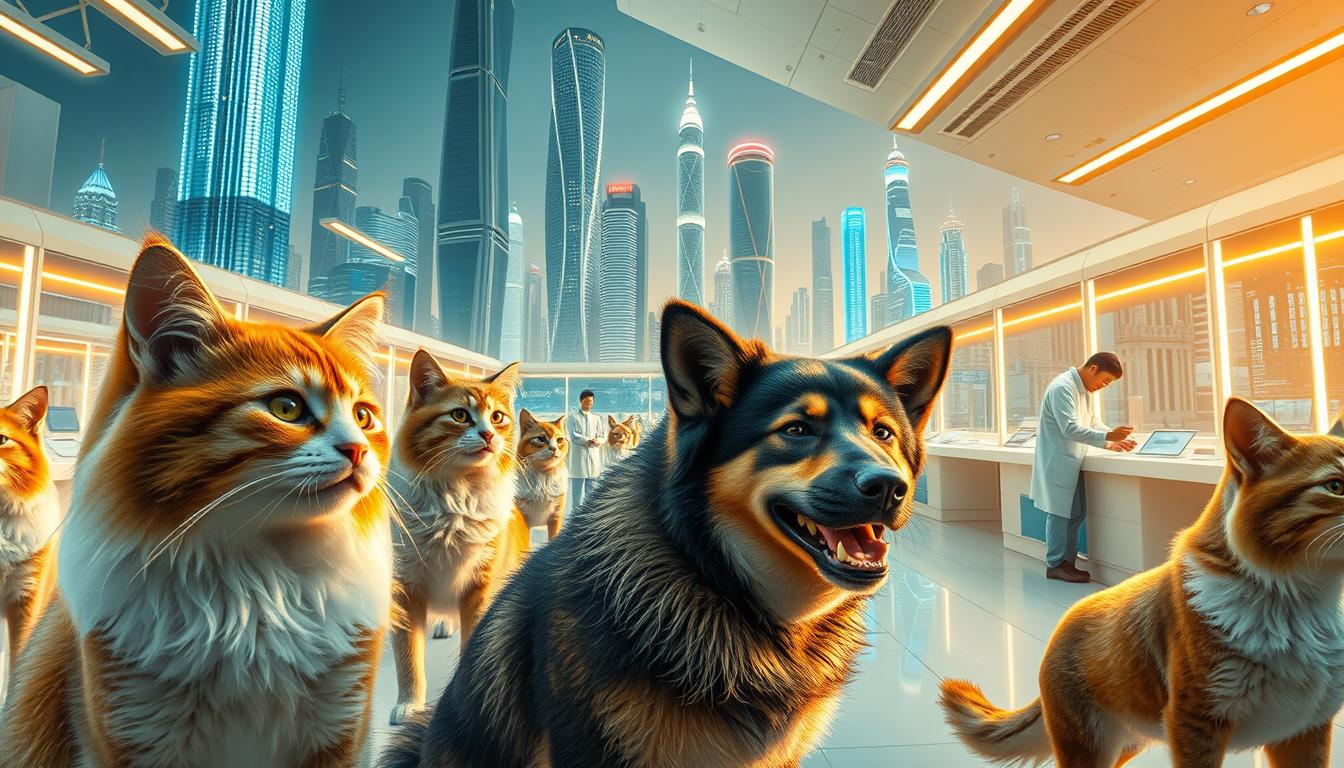
When Liu Xing’s cat Mao Mao died last year, she decided to clone it. She spent ¥140,000 (about $19,300) to bring back her beloved pet. She said it was like getting a second chance at love.
But this isn’t just a heartwarming story. It’s a big deal in China, where many families have pets. There are 124 million furry dependents in urban homes.
China’s animal economy is booming, with a value of ¥300 billion ($41 billion). Goldman Sachs says there are 46% more cats than children under 12 in big cities. Labs are now making designer pets, treating them like permanent family members.
Is cloning pets more appealing than having a child? The numbers suggest a shift in what we value. A Shanghai geneticist joked, “We can bring back the dead, but can’t get millennials to date.”
This isn’t your grandma’s pet industry. It’s a mix of science, economics, and ethics. We’re creating new companions, but is it a form of addiction?
How Pet Cloning Works
In today’s world, where you can 3D-print latte art and ChatGPT writes breakup texts, cloning pets seems inevitable. China’s biotech labs offer this service for $50,000. But how does it work? Let’s explore it step by step.
The Science of Second Chances
Think of your dog’s DNA as an IKEA instruction manual. Companies like Sinogene take a skin sample. They use somatic cell nuclear transfer (SCNT) to swap the nucleus of a donor egg with your pet’s DNA. It’s like making a new plushie from your old teddy bear’s stuffing.
From Skin Cell to Carbon Copy
The biological magic gets complex here:
- The reprogrammed egg gets zapped with electricity to start cell division
- Embryos are implanted in a surrogate mother (like a frustrated IKEA assembler)
- After 60 days of canine pregnancy, your “original” pet 2.0 is born
But, there’s a catch. Huang Yu’s cloned cat Garlic had different facial markings and a TikTok-addicted personality. Environment plays a huge role in their development. When one client got six cloned puppies instead of one, the lab joked about it for months.
This cloning comes with a warning. You’re getting a biological twin, not a copy-paste. The $50k price tag only covers the hardware. The software (personality) installs differently each time. It’s like your iPhone clone would have your ex’s number in Contacts.
Stories from China’s Pet Owners
In China, pet cloning is not just about making new pets. It’s about answering life’s biggest question: How much would you pay to never say goodbye? People clone pets for luxury or as a substitute for lost loved ones. These stories show how cloning labs have become emotional time machines.
Grief, Gucci, and Genetic Resurrection
The Wangs of Shanghai are like that couple who’d clone their car if they could. They spent $53,000 to clone their Persians, Mimi and Mao. Mrs. Wang told China Daily, “Why buy art when you can wear living couture?“
The Zhangs in Chongqing cloned their shih tzu, Lingling, three months after she died. “She was our only ‘child’ for 14 years,” Mr. Zhang said. Pet psychologist Liu Xiaoxia calls this “humanized pet culture.” Cloned animals become living memorials for China’s shrinking families.
Weibo’s hot takes show the cultural divide:
- “Cloning lets us cheat the grief cycle – it’s basically tech-enabled denial!” @PawPhilosophy
- “Rich people cloning Persian cats while strays roam the streets? Peak late-stage capitalism.” @AnimalRightsWarrior
This trend reveals deeper currents:
| Motivation | Wangs (Status Seekers) | Zhangs (Grievers) |
|---|---|---|
| Key Driver | Social media clout | Emotional replacement |
| Cost Justification | “Living luxury goods” | “Priceless family member” |
| Public Perception | Ostentatious | Sympathetic |
Cloning is China’s newest niche pet trend. It’s not just copying pets; it’s replicating the complex human needs they fulfill. Whether for vanity or emotional support, these genetic duplicates raise deep questions.
Sports Breeds & the Rise of Agility/Show Dogs
In a world where dog shows are as intense as a Game of Thrones finale, China’s cloning labs are changing the game. No need to wait years for a new champion. Just copy a top Border Collie’s DNA and create a new one.
Designer Genes in the Winner’s Circle
Sinogene cloned an Arctic wolf in 2023, showing the power of genetic traits. Imagine using this tech for agility dogs. A Beijing breeder said, “We’re not playing God, just optimizing his blueprints.”
Cloning a top agility dog costs $50k-$100k. But with stud fees at $15k, it’s a ROI even Warren Buffett would envy. The global show dog market is projected to hit $11.4 billion by 2027, facing a Black Mirror moment.
| Breed | Avg. Cloning Cost | Competition Wins (Cloned vs Natural) | Traits Prioritized |
|---|---|---|---|
| Border Collie | $68,000 | 83% vs 79% | Speed, Focus, Hip Health |
| Pekingese | $92,000 | 91% vs 62% | Coat Texture, Gait, Temperament |
| German Shepherd | $74,500 | 78% vs 81% | Muscle Memory, Joint Stability |
The Pekingese Premium
Cloning a show-ready Pekingese costs 35% more. It’s all about their imperial legacy markup. These dogs were once carried by Chinese emperors and now are prized in the CRISPR era.
Cloned Pekingese puppies often outperform their originals. They have no birth defects and better muscle tone. It’s like having a remastered Mona Lisa.
Ethics, Regulation, and Commercial Future
China’s pet cloning boom is changing the game in biology and ethics. Imagine a world where people can clone their pets with just a credit card. Activists cry out, saying it’s like playing with Frankenstein’s monster.
With 460 million people discussing it online, we’re facing a big question. It’s not just about cloning animals. It’s about the eternal battle between our dreams and our morals.
Playing God or Progress?
The real question is about love and ego. Is cloning a pet a sign of love or just a selfish act? PETA calls it a “furry Frankenstein project.”
But for people like Mrs. Li in Shanghai, it’s about love. She says cloning her pet is not playing God. It’s just finishing a story that was left unfinished.

Science gets complicated here. For every cloned dog that goes viral, there’s a beagle in a lab. Animal welfare groups say we’re treating animals like disposable tools.
China’s rules for cloning are a bit of a mess. It’s like there’s more control over street food than genetic engineering. The rules are like a Dr. Moreau storybook.
In the future, expect clone tourism to become big. Imagine fancy “gestational hotels” where people watch their future pets grow. It’s like Westworld meets the Westminster Dog Show, with big ethical questions.
As one lab tech in Beijing said, “We’re not just making better pets. We’re making a world where your pet’s warranty never ends.”
Global Comparison
In America, people argue about cloning pets, while in China, biotech firms clone dogs like toys. A $50,000 cloned golden retriever in Beijing shows more than just a pet. It’s a sign of cultural values. How did we reach this point?
East vs West in the Clone Zone
In China, cloning pets is seen as a way to avoid grief. But in the U.S., ViaGen Pets offers a different view. For $50k, you can clone a dog or help 500 shelter dogs. Most Americans choose the latter.
But, there’s a surprise. Even in the West, scientists dream of cloning extinct animals. Texas-based Colossal Biosciences wants to bring back dire wolves. It’s a mix of science fiction and big money.
What we value shapes these niche pet trends. In China, people want exact copies of their pets. In the West, it’s about cloning working dogs or designer breeds. It’s a choice between emotional comfort and practical use.
| Factor | China | United States |
|---|---|---|
| Average Cloning Cost | $30,000 | $50,000 |
| Primary Motivation | Emotional attachment | Genetic preservation |
| Notable Projects | Replicating family pets | Dire wolf de-extinction |
| Public Perception | Technological pride | Ethical debates |
This table shows two worlds looking at science differently. Beijing sees progress, while Washington worries about ethics. But they both agree cloning can change how we see pets. The future could bring back extinct animals or clone pets exactly. It all depends on where you are.
When Fluffy 2.0 Becomes the New Normal
China’s biotech pet revolution is already underway. By 2040, cloned corgis could be as common as iPhones in Shanghai. Analysts say the market could grow three times by 2033, thanks to grieving millennials and dog shows.
But there’s a messy truth beneath the surface. We’re not just copying DNA; we’re changing what it means to have a pet.
Capitalism meets CRISPR, and the magic begins. Imagine designer breeds with special fur or built-in trackers. But for every viral video of a cloned golden retriever, there’s a big question.
Are we solving urban loneliness or creating genetic monocultures? Are we making custom pets or just fancy NFTs?
Western critics say it’s playing God. Chinese tech giants see it as progress. In Beijing, cloned Shih Tzus now outnumber natural ones in high-rises.
It’s a world where “authentic” is old news. Your pet’s health history comes on a USB drive.
The big question isn’t about making a better Best Friend 2.0. It’s whether we’ll remember what made version 1.0 special. As biotech pets become more common, their success depends on more than just tech.
Can we patent a soul?